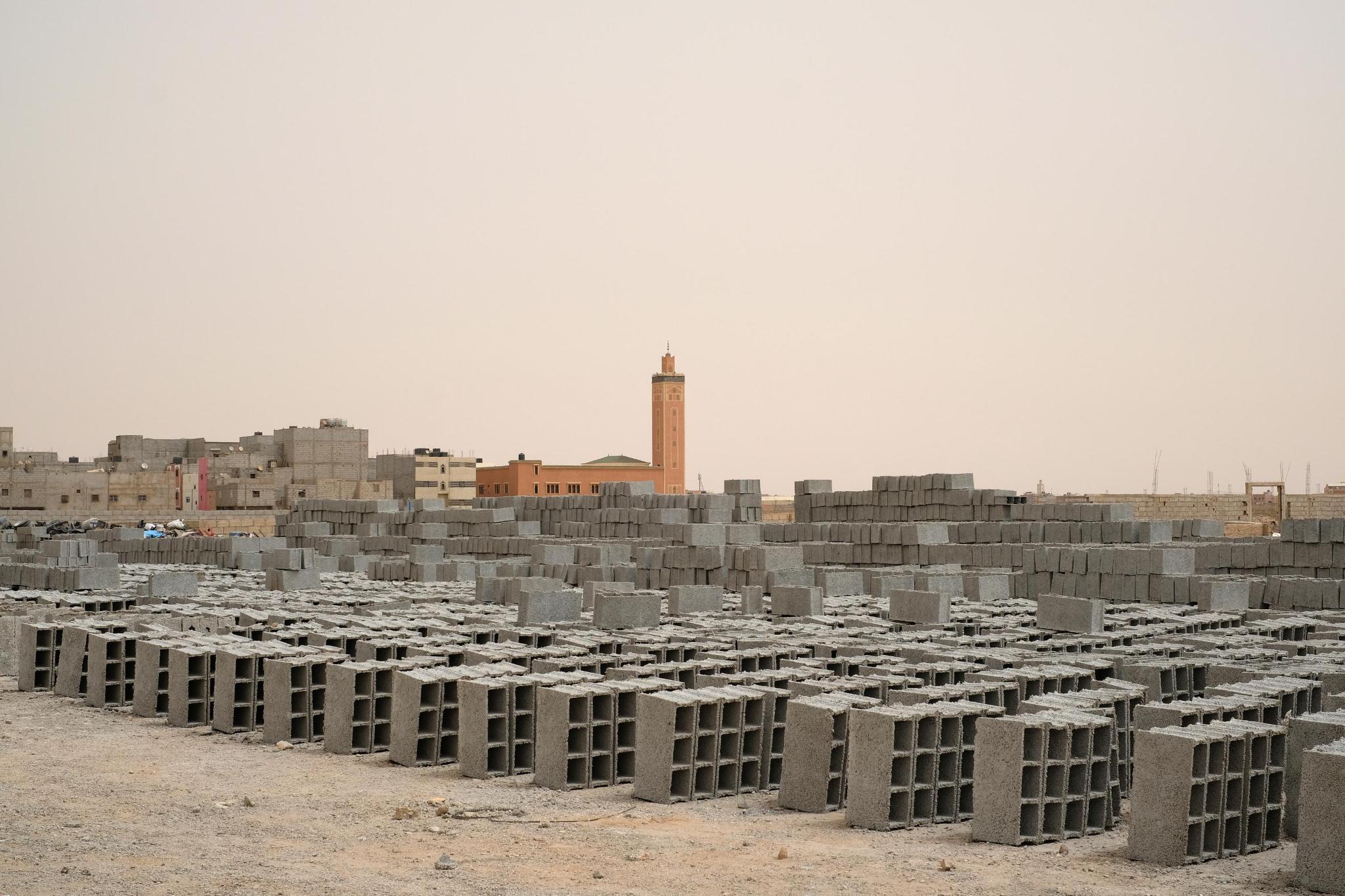
Moroccan budget documents released in late October reveal that the kingdom allocated tens of thousands of hectares of land in occupied Western Sahara to investment projects.
Photo: Elli Lorz.
Recently published data published by the Moroccan government reveals the alarming scale of public land allocation across occupied Western Sahara.
The figures appear in consecutive editions of the Rapport sur le Foncier Public Mobilisé pour l'Investissement (“Report on Public Land Mobilised for Investment”), annexed to Morocco’s 2026 and 2027 Finance Bills, and published by Morocco’s Ministry of Economy and Finance. The 2026 report can be found here, the 2027 report here.
The reports lay bare how Morocco’s administrative apparatus is slicing up Saharawi land to investment projects, entrenching its illegal presence and luring domestic and foreign corporate entities. By treating Dakhla-Oued Eddahab and Laâyoune-Sakia El Hamra - two administrative regions carved out by Morocco in Western Sahara - as domestic territory, the Moroccan state uses its private domain registry (Domaine Privé de l’État) to allocate extensive tracts of land for commercial exploitation.
The consolidated data for 2024, 2025, and the first half of 2026 reveals a multi-sector pillaging strategy spanning mega-concessions, renewable energy projects, mining, and agro-industrial development.
The budget documents do not address why Morocco believes to control the land areas that it is now allocating for industries. Saharawis who own the land in the territory are generally not compensated and are too afraid to speak out. Western Sahara scores among the lowest ranked countries and territories in the world on political freedoms.
The massive spatial disparity: Western Sahara vs. Morocco proper
The figures reveal a striking geographic concentration in Morocco’s public land allocation system, with Western Sahara - over which Morocco has no international mandate or sovereignty - accounting for the overwhelming majority of the land mobilised
- In 2024, a staggering 95.70% of all public land mobilised for investment across Morocco’s administrative framework was located in Western Sahara. Of 48,914 hectares reported globally, 46,811 hectares were allocated in the occupied territory, leaving just a 4.30% sliver of distributed land mass for Morocco proper. 46,811 hectares is an area equivalent to around 65,500 standard football pitches - or 220 times the size of Monaco.
- In 2025, the total area mobilised by the Moroccan government fell to 31,977 hectares. Nevertheless, the two administrative “regions” that Morocco has imposed on Western Sahara continued to account for a substantial proportion of the total, together representing 50.4% of the land area mobilised under Morocco’s administrative framework.
- During the first half of 2026, 94.95% of all mobilised land - 22,193 hectares out of a total of 23,374 hectares - was allocated in occupied Western Sahara.
These figures raise fundamental questions about the purpose and geographic priorities of Morocco’s public land allocation policy, particularly given Western Sahara’s distinct status under international law. The references to the Moroccan “regions” in the following are using Moroccan terminology, as applied in the government reports.
Laâyoune-Sakia El Hamra: Renewable Energy and Mining Expansion
In the northern part of occupied Western Sahara, large-scale infrastructure projects - particularly in renewable energy - account for a significant share of the land mobilised for investment. The region is also emerging as a major destination for mining-related land allocations.
- Morocco mobilised 16,869 hectares in Laâyoune-Sakia El Hamra for 72 investment projects, with projected investment totalling approximately 6.07 billion dirhams. Renewable energy dominated the allocation figures. The report records 15,664 hectares mobilised for six energy projects globally, approximately 96% of which was concentrated in Laâyoune-Sakia El Hamra. One project highlighted by the Ministry was a wind farm in Boujdour, valued at approximately 4.5 billion dirhams. The region also accounted for 86% of the total land area allocated to agro-industrial projects nationwide, equivalent to a reported 1,574 hectares across Morocco and Western Sahara.
- The acreage grab remained relentless in 2025, capturing 47.2% of the entire land area mobilised across the Moroccan regime's framework. Energy projects dominated its allocation profile, representing 96.54% of the land allocated in the region and 96.03% of projected investment. Major projects included a 2,500 million-dirham (MDH) wind farm planned for Laâyoune and two wind farm installations in Boujdour with a combined reported value of 4,350 MDH.
- In the first half of 2026, Mining emerged as a further focus of land allocation. According to the report, Laâyoune-Sakia El Hamra accounted for 99.63% of the total land area allocated to mining projects in Morocco and Western Sahara combined. Of the total of five mining projects recorded, three were located in this part of the occupied territory.
Dakhla-Oued Eddahab: Mega-Concessions, Mining, and Agro-Industrial Expansion
Further south, in Dakhla-Oued Eddahab, land allocation has centred on large-scale concessions and projects spanning green hydrogen, mining, tourism, and agriculture. The figures point to significant changes in the sectors receiving land over the three reporting periods.
- 2024: Although the Ministry listed projects across services, tourism, and agriculture, the underlying figures indicate an extraordinary concentration of land in two large integrated concessions. Together, these accounted for 98.81% of the region’s 29,580 hectares mobilised for investment. The concessions established substantial land footprints for the planned development of a green hydrogen industry. The scale of these allocations was also reflected in the transfer mechanisms: 63% of the land was reportedly allocated through cession (transfer of ownership), rather than location (leasing).
- In 2025, Dakhla-Oued Eddahab ranked first in the nationwide registry by number of approved projects, accounting for 28.25% of all approvals. Mining dominated the region’s allocated land area, representing 73.11% of the total. Meanwhile, services accounted for 44.83% of individual project files, followed by tourism projects at 17.24%.
- In the first semester of 2026, the allocation profile shifted towards agro-industrial development. Of the 354 hectares mobilised for investment during the first six months of the year, more than 88% was allocated to the agro-industrial sector. This points to an increased emphasis on commercial agriculture, including greenhouse production and food-processing operations geared towards international markets.
International Law and Corporate Liability
The Moroccan state's own financial documents show the staggering scale of what is taking place: tens of thousands of hectares are being distributed to corporate actors on stolen sovereign soil. This multi-year policy stands in direct violation of international law.
These allocations must be considered in light of Western Sahara’s distinct legal status. In its 1975 advisory opinion, the International Court of Justice found that the historical ties it examined did not establish territorial sovereignty over Western Sahara that would displace the Saharawi people’s right to self-determination.
Furthermore, the Court of Justice of the European Union (CJEU) reaffirmed in its historic October 2024 judgments that Western Sahara is separate and distinct from Morocco for the purposes of EU law and addressed the requirement for the consent of the people of Western Sahara in relation to agreements affecting the territory.
These legal findings have significant implications for companies and foreign consortia considering investments in the occupied territory. Businesses involved in land transfers, leases, or resource-extraction projects must assess whether their activities comply with international law and respect the Saharawi people’s right to self-determination.
Since you're here....
WSRW’s work is being read and used more than ever. We work totally independently and to a large extent voluntarily. Our work takes time, dedication and diligence. But we do it because we believe it matters – and we hope you do too. We look for more monthly donors to support our work. If you'd like to contribute to our work – 3€, 5€, 8€ monthly… what you can spare – the future of WSRW would be much more secure. You can set up a monthly donation to WSRW quickly here.
Guterres reminds Morocco: Self-determination still stands
In one of his final statements as UN Secretary-General, António Guterres has made an unequivocal point: the end of MINURSO does not extinguish the inalienable right of the Saharawi people to self-determination. It is a reminder that Morocco cannot declare the Western Sahara question closed simply because the UN mission is leaving.
When countries defend self-determination while voting against it
Our analysis of yesterday's UN Security Council vote on Western Sahara reveals a striking gap between what some governments said about the Saharawi people's right to self-determination and the resolution they voted to support.
US and Russia veto competing Western Sahara resolutions, leaving MINURSO’s future uncertain
In an extraordinary confrontation, both permanent members blocked each other’s proposals on Western Sahara. With no resolution adopted, the UN mission faces an imminent expiry of its mandate.
SRI update
The following overview enlists stock-exchange registered companies with current or recent operations in occupied Western Sahara. Updated 28 October 2026.